

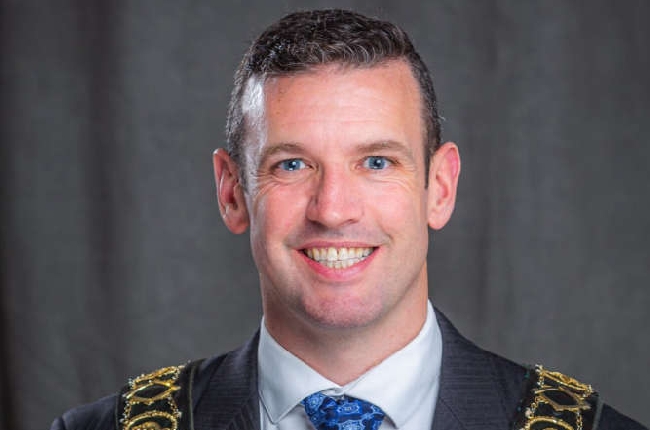
In the week leading up to the 2026 Municipal Election, we will be featuring profiles for candidates running for Mayor in Niagara's three largest municipalities - St. Catharines, Niagara Falls and Welland.
Today's profile is Mat Siscoe, who is running to be re-elected as Mayor of St. Catharines. Siscoe was elected in 2022, filling the seat left vacant by Walter Sendzik. Siscoe was victorious with over 68% of the vote, defeating Mike Britton and Nick Petrucci. Prior to being Mayor, Siscoe served three terms as a St. Catharines Councillor, and is a former teacher at St. Paul Catholic High School.
You've been talking to a lot of residents throughout the campaign, what's something you're hearing about the most, and what would you do if re-elected to help address that?
The biggest issue knocking on doors, because of all the flooding that we experienced this summer, has revolved around infrastructure. And I've been pretty proud to explain to folks that we tripled our investment in water, wastewater, and stormwater over the course of the last term of council. You know, we recognize there was an infrastructure deficit in that area. And so we've tried to put the investment there. You know, but I'm also very honest with people that I think taxpayers are stretched too thin. And at this point, we can't just keep piling things on the property tax base and on water rates. We need help from the upper levels of government. So the province and the federal government need to help pay their share of the infrastructure deficit. I've had really good conversations. My job, I think, as mayor is to continue advocating to those upper levels of government and say, "Listen, you have to help us. Our taxpayers are stretched thin, but we know we have these infrastructure issues." The city's 150 years old. We have infrastructure in some cases that is that old. And we've tried very hard to put property tax dollars and water rate dollars towards it, but we need additional help. So I think that's job number one. And I have the relationships at Queen's Park and on Parliament Hill that I think will stand up in good stead to get some movement.
Property taxes are a major concern for many residents. Is it difficult to keep taxes affordable with the need to maintain roads, infrastructure and municipal services?
It is, but I mean, that's part of the reason why, in this past term, I brought in a core service review, which helped us get a much better handle on what services we should be offering, where we should be putting our dollars. The second phase of the financial plan is what we call value-for-money audits, going department by department, looking at areas where we spend, comparing it to how other cities and municipalities of a similar size spend their money, and then making decisions based on that about where we can find savings to put dollars, you know, potentially towards infrastructure or also potentially to savings for residents. It's a plan that we've come up with. We expect the first value-for-money audits to be done in the new year, and we think we can find some significant savings from that.
Niagara continues to grow. How should St. Catharines handle new development and housing while making sure infrastructure and services can keep up with that growth?
We've taken a pretty measured approach here in St. Catharines. We said yes to some developments, but we also said no to developments where we felt like they just didn't fit with the community, where we didn't think the infrastructure was capable of handling, you know, the influx of new housing units. You have to keep taking a measured approach. We're also going to advocate to the province because, I mean, we've seen situations where council has said no, we've listened to our community, and then it's been overturned at the Ontario Land Tribunal, and that provincial body has given permission to something the community was very clear they didn't want. I think we have to keep taking that measured approach. We have to ensure that any development that comes in, they have to prove that there's enough capacity within the infrastructure system to be able to accommodate it. That's something we've been diligent about, and I think it's paying dividends for residents in St. Catharines.
What do you believe Niagara's municipalities and the Region should be doing differently together, and what would you personally do as mayor to improve regional cooperation?
I think there's pretty broad agreement amongst the mayors that local area municipalities, the cities and towns, need to have more control over their infrastructure and more power to dictate where the dollars are being spent on infrastructure, roads, sidewalks, and sewers. But I also think we have to have good relationships across municipalities so that when we're making decisions on behalf of Niagara residents as a whole, we're looking at it through a Niagara lens. And I think I've demonstrated this term of council. I have good relationships with mayors across the spectrum, whether they're smaller, more rural municipalities or the bigger urban municipalities. Those partnerships ensure that public health and social services are being properly delivered, that we're doing the region-wide economic development work that's done. Those relationships stand us in good stead. And, you know, there's a lot of change coming to the governance of Niagara Region, and I can hit the ground running. You know, there's no learning curve for me. I think I've demonstrated pretty strong, stable leadership over the last four years, and I think that continues on day one of the next term.
If re-elected, what is one thing you would do that residents would actually notice within your first year?
I think in the first year of the new term, the one thing, probably the biggest, is the financial reforms that we brought to St. Catharines: the core service review, the value-for-money audit. We finally, at the end of the last term, got the region to agree to start moving through that process. So I'm hopeful that we're going to see some very positive results as a part of the 2027 budget at the region. If you take a look at the property tax increases over the last couple of years, they're largely driven by increases at the region, which is why we needed those financial reforms. I'm proud of the fact, even though it took a lot longer than it should have, I'm proud of the fact that I was able to convince regional council to go through a core services review. The next step, just like in St. Catharines, will be value-for-money audits at the region to make sure the taxpayers are getting good value.
Four years from now, what do you want residents to be able to point to and say, "That's what Mayor Siscoe accomplished in his second term"?
The reason I got into the mayor's race in 2022 was because I was concerned about infrastructure. And at the time, folks weren't really talking about infrastructure. Obviously, this past summer has caused people to pay much closer attention to infrastructure, especially the stuff we can't see under the ground. I would hope at the end of this term, residents can look back on my then two terms in office and recognize that we did the unsexy things. We did the difficult things that we had to get done to make sure that residents could feel safe and secure in their homes, that they had roads that they could depend on, that the recreational infrastructure was there to meet their needs and the needs of their family, and that people felt we were building a community for the next generation.
Siscoe is one of five candidates running for Mayor in St. Catharines, alongside Ann-Marie Zammit, Jimmy Jackson, Anthony Adeoye and Henry Bosch.